Every founder who has tried to post consistently knows the pattern. Week one, three posts and real energy. Week two, one post. Week three, a board meeting, a supplier problem, a hire that fell through. Week eight, someone mentions your LinkedIn and you change the subject.
This gets diagnosed as a discipline problem. It is not. You run a company, so discipline is not what you lack. What failed was the design. Each post was a separate act of creation, started from zero, dependent on a free evening and a good idea arriving at the same time. Nothing built that way survives a hard month.
The fix is to stop making posts and build the thing that makes posts.
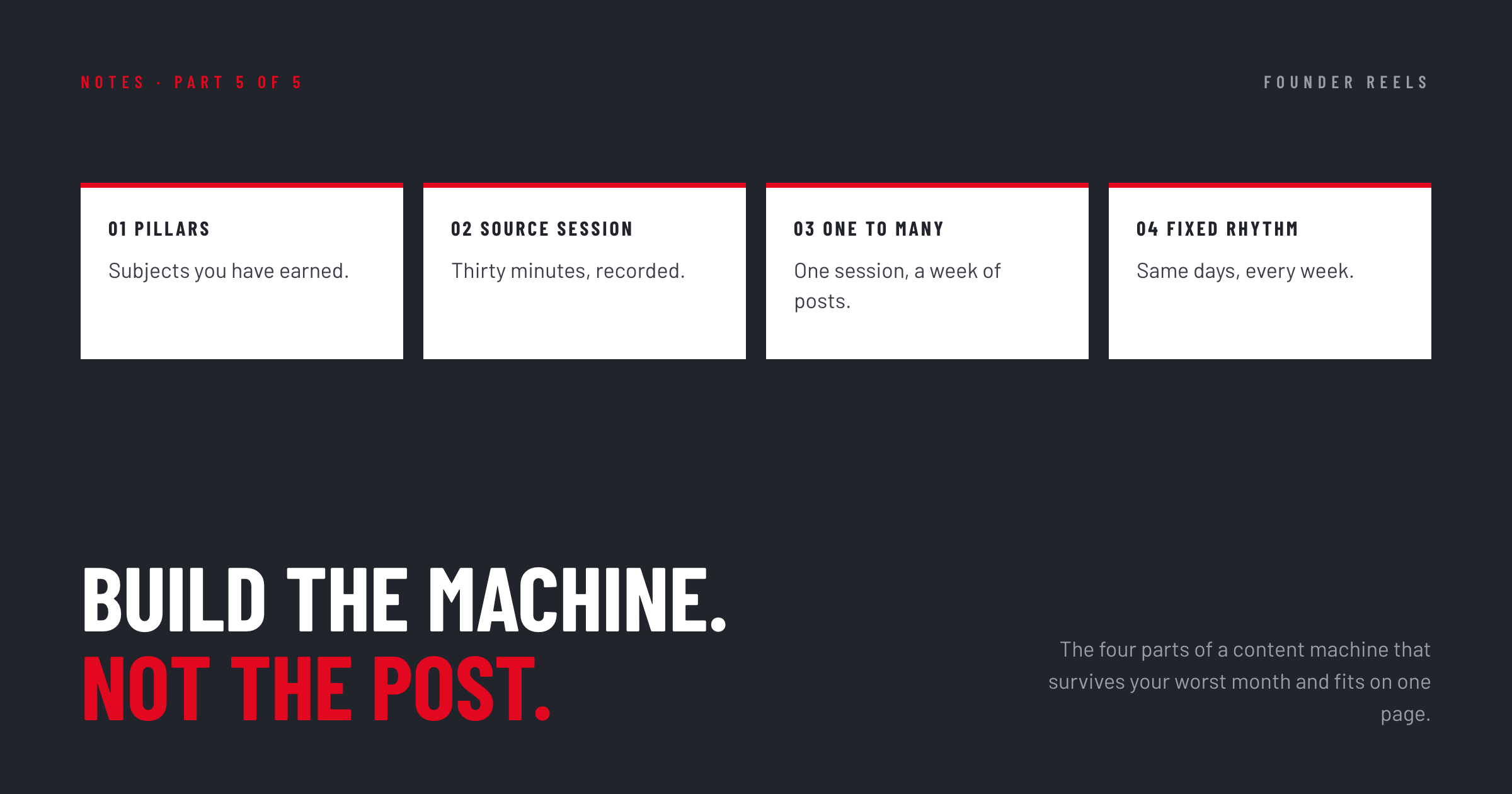
Part one: pillars
Three or four subjects you have earned the right to talk about. Not topics you find interesting. Subjects where your track record makes you hard to argue with.
Pillars do two jobs. They tell the right reader what you are for, because repetition is how positioning works in public. And they end the blank page. You are never asking what to write about. You are asking what happened this week that belongs to one of four subjects, and something always did.
This is why positioning comes before content. A machine built on vague positioning produces vague content efficiently. Volume on top of weak positioning just makes you generically visible.
Part two: one source session
Once a week, thirty minutes, recorded. Someone asks you questions inside your pillars and you answer out loud, the way you would to a smart peer over lunch. No script. If nobody is available to ask, write the questions the day before and answer them to the camera.
This is the only part of the machine that requires you, and it requires you to do the thing you are already good at, which is talking about your work.
The questions come from the work. What did a customer ask this week. What did you decide, and why. What did you watch a competitor get wrong. What do you believe now that you did not believe a year ago.
Part three: one to many
One thirty-minute session becomes a transcript. The transcript becomes two or three written posts, a few short clips if you recorded video, a section of a newsletter, and a handful of lines worth quoting. This is where AI and templates earn their place, as covered in the third note and the fourth.
The ratio is the point. Thirty minutes of your time in, a week of publishing out. Your cost per post drops to almost nothing, which is the only price a busy founder keeps paying.
If every post needs a fresh idea and a free evening, you do not have a system. You have a hobby.
Part four: a fixed rhythm
Same days, same order, every week. Record on Monday. Drafts back by Wednesday. You review and approve in one sitting, fifteen minutes, on Thursday. The queue publishes on schedule. Once a month, look at what earned replies from the right people and adjust the questions.
Review stays with you. Everything that goes out under your name gets read by you first. That is not the bottleneck it sounds like. Reading five drafts of your own words takes less time than writing one post from nothing.
The two tests
A machine is replicable when it passes two tests.
The worst month test. Picture your hardest month of the last year. Would this have kept running? If it needs more than a few hours a month from you, the answer is no, and you should cut it down until the answer is yes. A small machine that runs beats a large one that stalls.
The one page test. Could you hand the process to an assistant, a contractor, or a new hire on a single page, and have it run without explaining it twice? Write the page. Who records, and when. Where the file goes. Who drafts, and from what voice file. Who reviews. What gets scheduled where. If you cannot write that page, you do not have a machine yet. You have a habit, and habits break.
What you are actually building
Put the five notes together and they are one argument. Your hardest problems are trust problems. Trust is the asset you keep. AI makes the production cheap without making the voice fake. A small stack handles the handoffs. And a machine turns all of it into something that compounds while you run the company, which is the only version of this that survives contact with your actual calendar.
Positioning first, then content, then capture. If you want to know which layer is holding you back, that is what the report is for: Get Your Report.