There are two ways founders are using AI on their personal brand right now. One of them works.
The first way: open a chat window, type "write a LinkedIn post about leadership," and publish what comes back. The result is fluent, tidy, and indistinguishable from every other post produced the same way that morning. Readers have learned to spot it within a sentence. Once they spot it, they stop reading, and they trust the name above it a little less.
The second way treats AI as what it is good at being. An editor, a researcher, a production assistant. Never the author.
Why the first way fails
AI made competent writing free. Anything free and unlimited is worth nothing as a signal. A post that anyone could have generated tells the reader nothing about the person who posted it, and telling the reader something about you is the whole job.
What a model cannot generate is the part that is only yours. The deal that fell apart and why. The hire you got wrong. The opinion you hold that most of your industry does not. That is the raw material. It exists only in your head and in your history, and it is exactly what the people researching you are hoping to find.
Where AI belongs
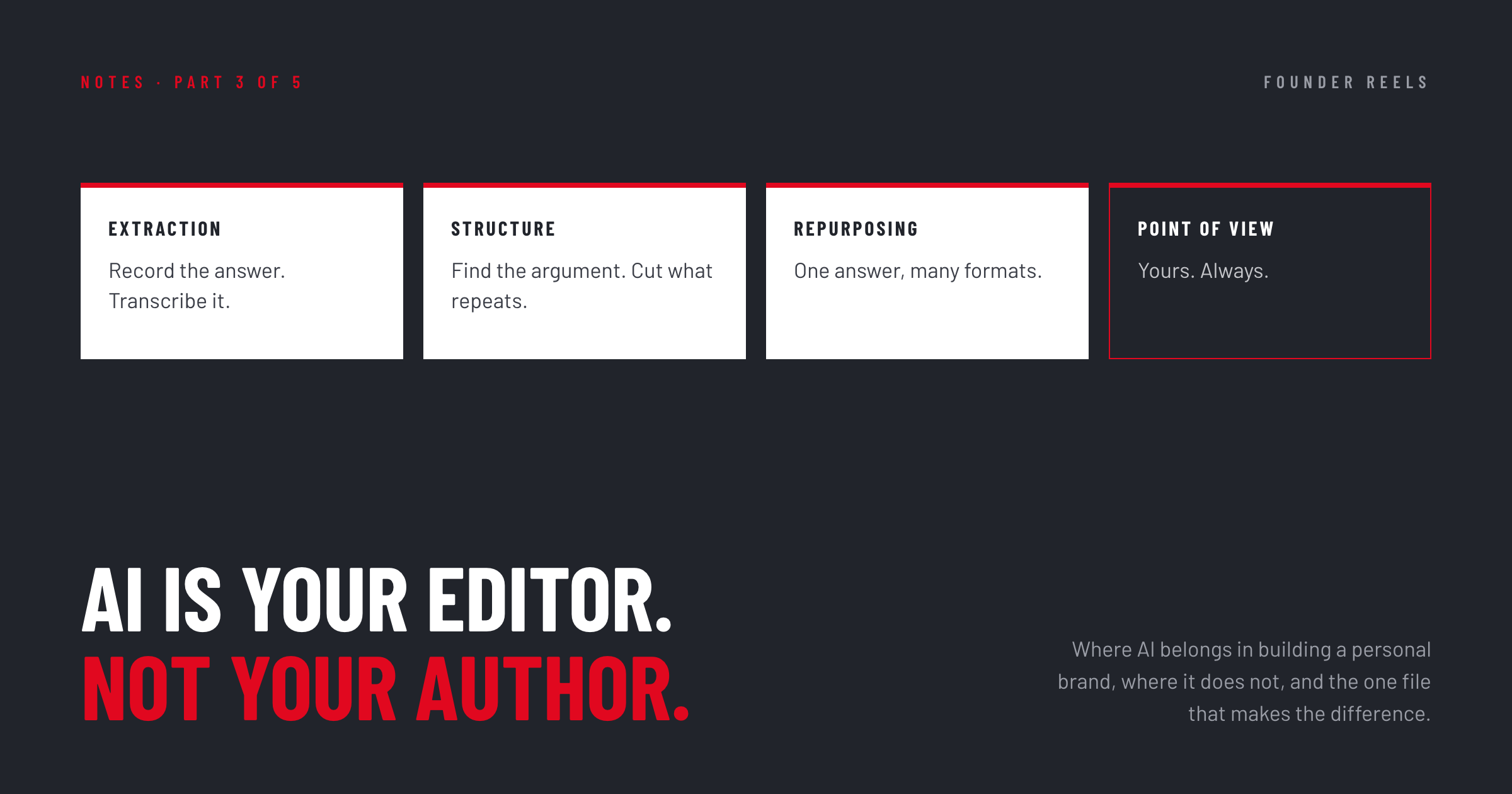
Use it everywhere except the point of view.
- Extraction. Talking is faster than writing, and most founders are better at it. Record yourself answering one good question for ten minutes. Transcribe it. You now have more original material than a week of staring at a blank page would produce.
- Structure. Hand the transcript to a model and ask it to find the argument, put it in order, and cut what repeats. It is rearranging your words, not inventing new ones.
- Repurposing. One recorded answer becomes a written post, a short video script, a newsletter section, and three quotes. This is mechanical work, and mechanical work is what the machine is for.
- Research. Checking a fact, condensing a long document, finding what has already been said on a subject so that you can say something different.
- Editing. Tighten this. Find the weakest paragraph. Tell me where a skeptical reader stops believing me.
The voice file
The difference between generic output and useful output is mostly what you give the model before you ask it for anything. Build one document for this. It will be the most valuable page in your system.
It holds:
- Who you serve and the specific claim you make, in one sentence each
- Your three or four content pillars, the subjects you have earned the right to talk about
- Five to ten samples of your own writing or transcribed speech that sound like you
- Rules. Words you never use, things you will not claim, how long your sentences run
- The proof you are allowed to cite: numbers, names, results
Every request to the model starts with that file. The output stops sounding like the internet and starts sounding like a rough draft of you.
Notice the first two lines of that file. They are positioning. If you cannot fill them in, no model will fix that for you, and everything it produces will be fluent and aimless. This is why we will not sell anyone content before positioning is done.
The test
Here is the test for anything AI has touched. Could you defend every sentence of it out loud, in a room, to someone who knows your industry? If yes, publish it. If there is a line you would not say in person, it goes, no matter how good it sounds.
You are not outsourcing your voice. Your point of view has to be yours or nobody will believe it. AI does not change that rule. It removes the last excuse for not having time.
This is the third of five notes on building a presence that runs like a system. The first two are Your hardest problems are trust problems and Your reputation is the asset you keep. Next: Your stack is five jobs, not fifteen tools.