Ask a founder about their content stack and you get one of two answers. Either there is nothing, and every post starts from a blank page at eleven at night. Or there are fifteen subscriptions, each bought after a convincing demo, none of them talking to each other, most of them unopened since the trial ended.
Both are the same mistake. They start with tools. A stack should start with jobs.
The five jobs
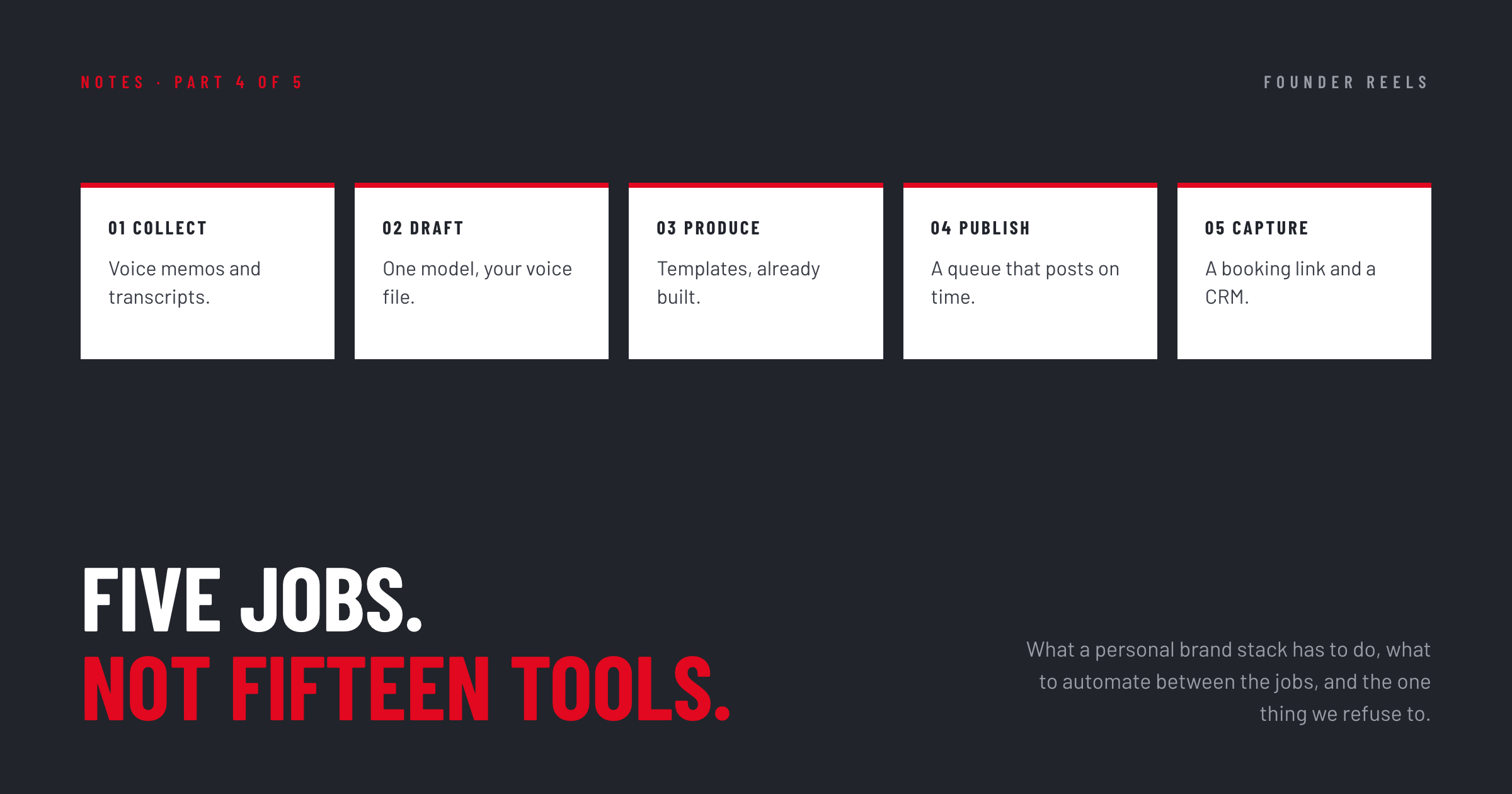
Everything a personal brand system does falls into one of five jobs. One tool per job is enough. Two is usually a sign that something is wrong.
- Collect. Getting raw material out of your head and your calendar. A voice memo app and a meeting transcriber cover it. The best ideas you have this month will be said out loud in a meeting, not typed into a document.
- Draft. Turning raw material into something publishable. One AI model, loaded with your voice file, as covered in the last note.
- Produce. Making it presentable. A design tool with your templates already built, and a simple video editor that adds captions. The templates matter more than the tool.
- Publish. A scheduler that holds the queue and posts on time, so that publishing does not depend on whether you remember on a Tuesday.
- Capture. A booking link, a CRM, and a follow-up sequence. Attention without a capture layer is a hobby.
That is the whole stack. If a tool does not do one of those five jobs, it is a subscription, not a system.
Automate the handoffs
The work inside each job needs judgment. What does not need judgment is the space between the jobs. That is where systems break, and that is where automation pays.
A transcript that files itself in the right folder the moment a meeting ends. A finished draft that creates its own review task with a due date. An approved post that drops into the scheduler without anyone copying and pasting. A form submission that creates the contact, sends the confirmation, and opens a task, all before you have seen the notification.
None of these is sophisticated. Each one removes a moment where the process depends on you remembering something. Add up enough of those moments and you have the real reason most content efforts die in week three.
How ours works
The Growth Report is a fair example, because it is a system I run myself.
Someone requests a report through a form on the site. The CRM creates the contact and sends the confirmation. The request becomes a task in a queue with a due date two business days out, because that is what the site promises. An AI model drafts the report from the public presence of the person who asked. Then I read every report against a checklist, ask for changes, and send it myself.
For the record, that is GoHighLevel, ClickUp, and Claude. The names matter less than the jobs. Swap all three and the system is the same.
The one thing we do not automate
Notice where the automation stops. The confirmation is automatic, because it says the same true thing to everyone. Anything that says something specific about a person waits for a person to press send.
That is deliberate. Everything upstream of the send button can be fast, cheap, and automatic. The moment something lands in front of another human with your name on it, it is your reputation, and your reputation is the asset this whole effort exists to build. One automated message that is slightly wrong costs more trust than a hundred correct ones earn.
So the rule for your own stack is simple. Automate collection, filing, formatting, scheduling, and reminders. Review anything that speaks in your voice. It takes five minutes, and they are the five minutes that matter.
Start smaller than you think
If you have nothing today, do not build all five jobs at once. Start with collect and publish. Record one answer a week and schedule one post a week. Add the rest when the absence of it starts to hurt.
A stack you grew into will still be running next year. A stack you bought in one weekend will not.
This is the fourth of five notes on building a presence that runs like a system. The series starts with Your hardest problems are trust problems. Last: Build the machine, not the post.