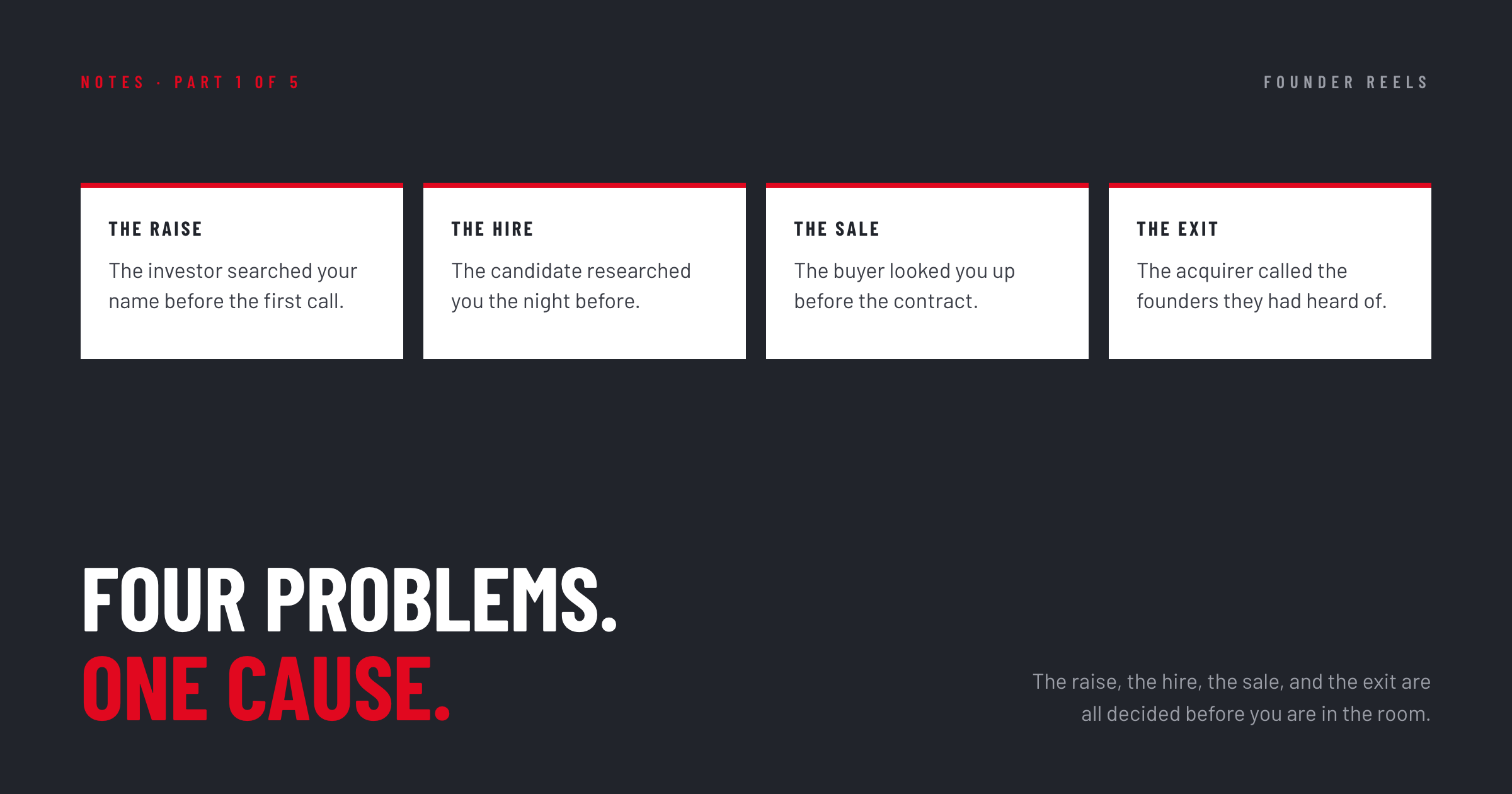
Ask a founder what is hard right now and you get a list. The raise is taking longer than the last one. The candidate you wanted took another offer. The sales cycle keeps stretching. The inbound that used to arrive on its own has gone quiet.
These get treated as four problems with four fixes. A better deck. A recruiter. Another salesperson. More ad spend. Sometimes those help. But look at what the four have in common. In every case, a specific person is deciding whether to believe you, and they are making that decision before you are in the room.
The constraint moved
For most of the last twenty years, capability was the hard part. Could you build the product. Could you produce the analysis, write the plan, ship the code. Being good at the work was enough to stand out, because good work was expensive to produce.
That is no longer true. AI has collapsed the cost of competent output. A credible deck, a sound strategy memo, a clean landing page: all of it is available to anyone in an afternoon. When everyone can produce good work, good work stops telling people anything about you.
What has not gotten cheaper is trust in a specific person. It cannot be generated. It can only be accumulated, in public, over time.
I have taken six hundred products to market across twenty years, and every one of them taught me the same thing. Distribution and trust are the constraint. Not capability. That used to be a lesson about products. It is now a lesson about founders.
Four problems, one cause
Take the list again.
- The investor searched your name before the first call. What they found set the tone of the meeting, or decided whether there was one.
- The candidate you wanted researched you the night before the final interview. They were choosing a person to work for, not a company.
- The buyer looked you up between the demo and the contract. They were checking whether the person behind the product is someone they can explain to their boss.
- The acquirer built a list of companies to call. The founders they had already heard of were at the top of it.
None of these people told you they were looking. Most of them decided before you knew you were being considered.
What they find
Here is what they usually find. A headline that is a job title. A profile last touched two years ago. Press, revenue, and results attached to the company name instead of to you. Twenty years of hard-won opinions, and none of them written down anywhere public.
The pattern in the reports we run is consistent. The credentials are strong. The presentation is generic. The problem is almost never what you have done. It is that nobody can see it, and what they can see does not have your name on it.
So the founder with the weaker product and the stronger presence takes the meeting. Not because they are better. Because they were legible at the moment someone was deciding.
Why this is good news
A trust problem sounds worse than a deck problem. It is actually better, for two reasons.
First, it is one problem instead of four. Fix what people find when they look you up and the raise, the hire, the sale, and the exit all get easier at once, because they all run through the same search.
Second, it is fixable with what you already have. You do not need a new track record. You need the one you have to be visible, attached to your name, and explained in a sentence a stranger can repeat.
That is what this series is about. Four more notes follow this one.
- Your reputation is the asset you keep: what a personal brand is actually worth to a founder
- AI is your editor, not your author: where AI belongs in building one, and where it does not
- Your stack is five jobs, not fifteen tools: the small stack that runs it, and what to automate
- Build the machine, not the post: how to turn all of it into something that keeps working while you are busy running the company. Which is always.
If you want to see what people find today, start here: Get Your Report. It is free, it takes two business days, and no call is required to receive it.