Founders are good at valuing assets. Inventory, equipment, intellectual property, a customer list. Ask what their own name is worth and most have never thought about it, because it does not appear on a balance sheet.
It should. It is the only asset in the business that you keep no matter what happens to the business.
What it actually is
A personal brand is not a logo, a color palette, or a posting habit. It is what the right people believe about you before you open your mouth. That belief exists whether you manage it or not. If you do nothing, it gets assembled from a job title, a stale profile, and whatever your company page happens to say.
The work is not inventing a persona. It is making sure the true story is the one people find.
Where the value shows up
It shows up in four places, and none of them is a vanity metric.
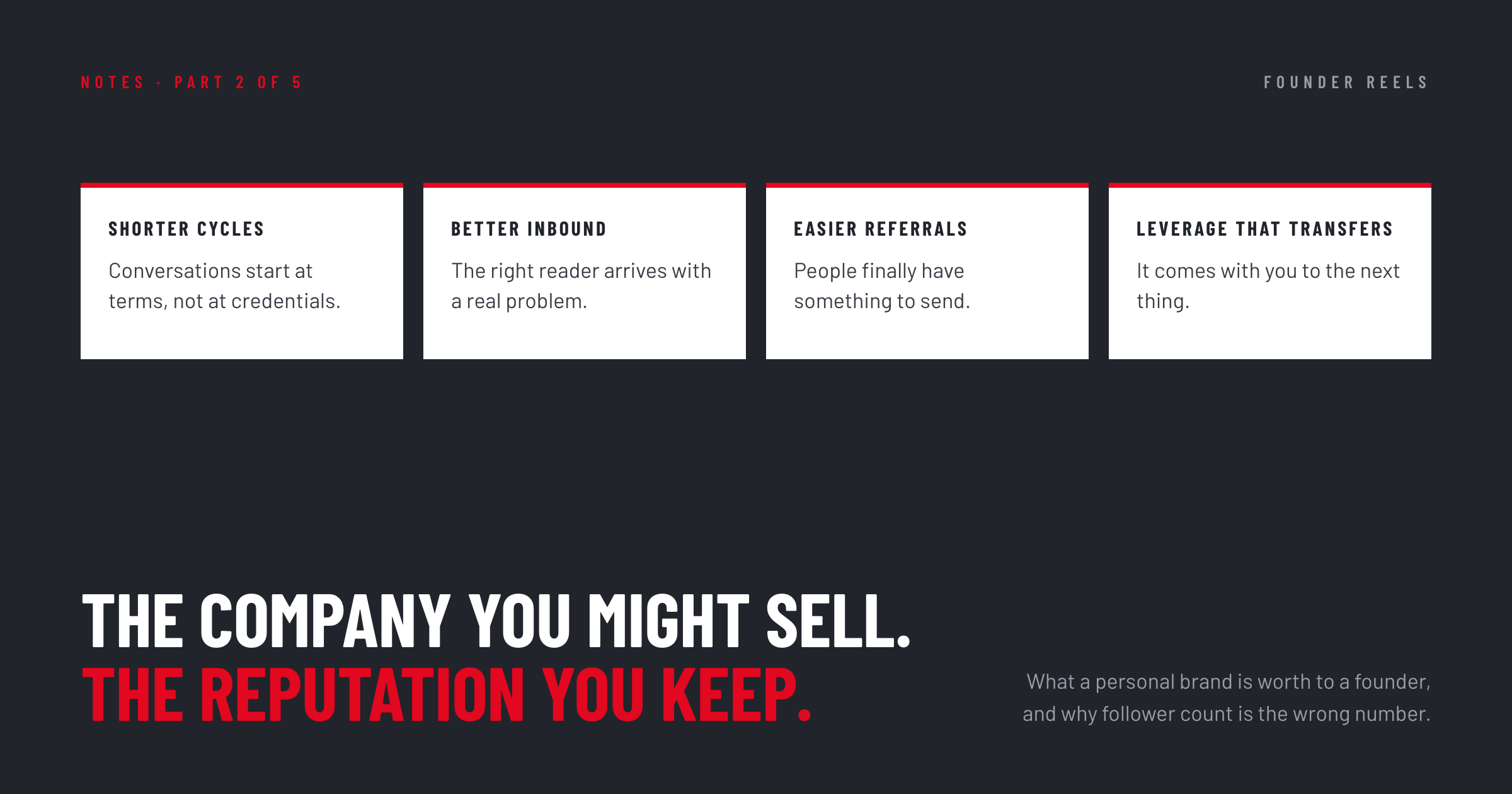
- Shorter cycles. When someone arrives already knowing what you do and why it matters, the conversation starts at terms instead of at credentials. You stop spending the first fifteen minutes of every room establishing who you are.
- Better inbound. Not more of it. Better. The right reader sees themselves in what you write and reaches out with a real problem instead of a vague question.
- Easier referrals. People who want to recommend you finally have something to send. A link does the introduction they do not have time to write.
- Leverage that transfers. Sell the company, leave the role, start the next thing. The reputation and the trust come with you. Nothing else you have built does that.
The portable asset
A product brand lives on a shelf and in a listing. It belongs to the company. When the company is sold, the brand goes with it, which is the point of building it. Your name does not work that way.
This matters more for founders than for anyone, because a founder career is a sequence of bets. The next company, the next raise, the next board seat all begin with the same question: who is this person. If the answer has to be rebuilt from zero each time, you are paying the same tax over and over.
It compounds, and it cannot be backdated
Every useful thing you publish keeps working after you publish it. It gets found in search, forwarded in a thread, remembered six months later when someone finally has the problem you wrote about. That is compounding, and like all compounding it rewards the early start more than the large effort.
It also cannot be bought later. When you need it most, for the raise or the sale or whatever comes after the exit, it is too late to start. People can tell the difference between a presence built over two years and one assembled the month before the roadshow.
A personal brand used to be something you built after the exit. That order is now backwards.
The wrong number
Follower count is the first thing people ask about and the last thing that matters. The goal is that the right forty people trust you, not that forty thousand strangers watch you.
Think about who actually changes your year. A founder selling enterprise software needs a few hundred buyers, a few dozen investors, and a handful of acquirers to know exactly what they do. That is a small room. It is also a reachable one.
Better questions to ask each quarter:
- Did anyone arrive already knowing what I do
- Did a conversation start further along than it used to
- Did someone I have never met refer to something I wrote
- Is what people find when they search my name true, current, and mine
If those are moving, it is working, whatever the follower count says.
This is the second of five notes on building a presence that runs like a system. The first is Your hardest problems are trust problems. Next: AI is your editor, not your author.